Orbi WiFi System
The Orbi WiFi System creates dedicated high-speed WiFi connections to your Internet service. The Orbirouter connects to your modem or gateway. The Orbi satellite extends the WiFi signal throughout your home.
This manual describes how to manage your Orbi WiFi System from your Orbi router web interface. You can manage any add-on Orbi satellite from the Orbi router web interface.
If you own one of the following add-on Orbi satellites, you can find more information about your satellite from its user manual, which is available at https://www.netgear.com/support/:
- Orbi Outdoor Universal Satellite (model RBS50Y)
- Orbi Voice (model RBS40V)
This chapter contains the following sections:
- LED behavior
- Connect your router
- Place your satellite
- Sync your Orbi satellite
- Set up an Ethernet backhaul connection
- Download the NETGEAR Orbi app
For more information about the topics covered in this manual, visit the support website at https://www.netgear.com/support/.
Note: This manual refers to all Orbi router models as the router and refers to all Orbi satellite models (including the Orbi wall plug satellite) as the satellite.
Orbi Login Guide
- Access your router easily using orbilogin or orbi login from any web browser.
- Make sure your device is connected to the Orbi WiFi network before proceeding.
How to Access Orbilogin.net
- Open a browser and type orbilogin.net in the address bar.
- You will be redirected to the orbi admin login page.
- Enter your username and password to continue.
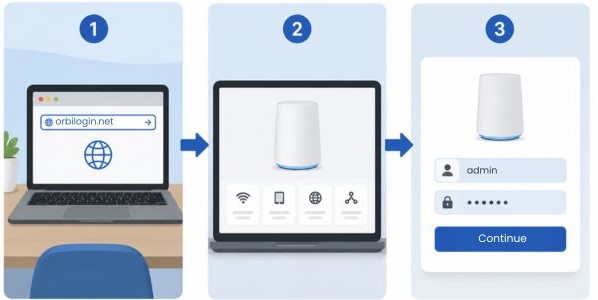
Features of Orbi Admin Login
- The orbi admin login panel lets you change WiFi name and password.
- You can manage connected devices using orbilogin interface.
- Perform firmware updates and security settings via orbi login.
Troubleshooting Orbi Login Issues
- If orbilogin.net is not working, try using the router’s IP address.
- Ensure proper connection to the network before accessing orbi login.
- Clear browser cache if the orbi admin login page doesn’t load.
Security Tips for Orbi Login
- Always keep your orbilogin credentials safe.
- Avoid sharing your orbi login details with others.
- Regularly update password through orbi admin login for better security.
LED behavior
When you sync a satellite to the router, the LED behavior for a satellite that comes in a WiFi system is different from the LED behavior for add-on satellites.
Orbi WiFi system LEDs
The following table describes the LED behavior for an Orbi router and Orbi satellites that are purchased together and come in the same package.
Table 1. Orbi WiFi System router and satellite LED descriptions
| LED Type | LED Behavior |
|---|---|
| Power LED | The Power LED is located above the Power On/Off button on the rear panel. Note: The wall plug satellite does not include a Power LED.
|
| Router Ring LED | The ring LED is located on the top.
|
| Satellite Ring LED | Included with Orbi satellite. Ring LED is located on the top.
|
Connect your router
- Unplug your modem’s power, leaving the modem connected to the wall jack for your Internet service. If your modem uses a battery backup, remove the battery.
- Plug in and turn on your modem. If your modem uses a battery backup, put the battery back in.
- Connect your modem to the Internet port of your router with the yellow Ethernet cable that came with your router.
- Connect the power adapter to your router and plug the power adapter into an outlet.
- If the Power LED does not light, press the Power On/Off button on the rear panel of the router.
Set up an Ethernet backhaul connection
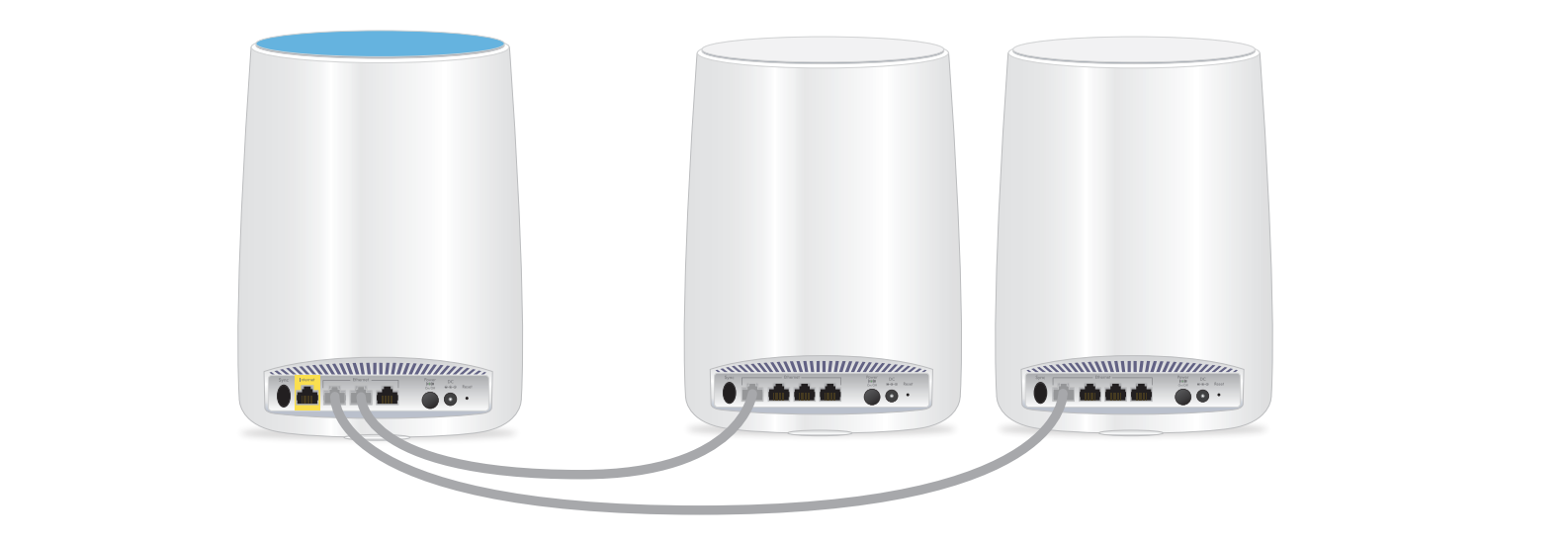
Your Orbi satellite automatically connects wirelessly to your Orbi router or another Orbi satellite to create a wireless backhaul, or you can use an Ethernet cable to connect your satellite to your router or another satellite to create a wired backhaul connection.
Before you set up an Ethernet backhaul connection, make sure that you update the firmware on all your Orbi devices.
The following image shows how to connect your Orbi satellites to your Orbi router to create an Ethernet backhaul connection.
Download the NETGEAR Orbi app
You can use the NETGEAR Orbi app to set up and access your Orbi network.
To find the app, scan a QR code or search for NETGEAR Orbi in the Apple App Store or Google Play Store. Launch the NETGEAR Orbi app on your mobile device and follow the prompts.
For more information about the Orbi app, visit
https://www.netgear.com/home/apps-services/orbi-app. 
Factory settings for Orbi router model RBR50
The following table shows the factory default settings for the router.
| Feature | Setting | Default Value |
|---|---|---|
| Router Login | User login URL | orbilogin.com |
| User name (case-sensitive) | admin | |
| Login password (case-sensitive) | password | |
| Internet Connection | WAN MAC address | Use default hardware address |
| WAN MTU size | 1500 | |
| Port speed | AutoSensing | |
| Local Network (LAN) | LAN IP | 192.168.1.1 |
| Subnet mask | 255.255.255.0 | |
| DHCP server | Enabled | |
| DHCP range | 192.168.1.2 to 192.168.1.254 | |
| DHCP starting IP address | 192.168.1.2 | |
| DHCP ending IP address | 192.168.1.254 | |
| DMZ | Disabled | |
| Time zone | GMT for WW except NA and GR, GMT+1 for GR, GMT-8 for NA |
|
| Time zone adjusted for daylight saving time | Disabled | |
| SNMP | Disabled |
Technical specifications for Orbi router model RBR50
The following table shows the technical specifications for the router.
| Feature | Description |
|---|---|
| Data and routing protocols | TCP/IP, RIP-1, RIP-2, DHCP, PPPoE, PPTP, Bigpond, Dynamic DNS, UPnP, and SMB |
| Power adapter |
|
| Dimensions | 6.7 × 3.1 × 8.89 in. (170.3 × 78.9 × 225.8 mm) each |
| Weight | 1.96 lb (890.5 g) |
| Operating temperature | 0° to 40°C (32° to 104°F) |
| Operating humidity | 90% maximum relative humidity, noncondensing |
| Electromagnetic emissions | FCC Part 15 Class B VCCI Class B EN 55 022 (CISPR 22), Class B C-Tick N10947 |
| LAN | 10BASE-T or 100BASE-TX or 1000BASE-T, RJ-45 |
| WAN | 10BASE-T or 100BASE-TX or 1000BASE-T, RJ-45 |
| WiFi | Maximum wireless signal rate complies with the IEEE 802.11 standard |
| Radio data rates | 2.4 GHz: Max. 400 Mbps 5 GHz Front haul: Max. 866 Mbps 5 GHz Back haul: Max. 1733 Mbps |
| Data encoding standards | IEEE 802.11b/g/n 2.4 GHz – 256 QAM support IEEE 802.11a/n/ac 5 GHz – 256 QAM support |
| Maximum number of computers per wireless network | Limited by the amount of WiFi network traffic generated by each node (typically 50–70 nodes) 2.4 GHz: 127 5 GHz (front haul): 127 |
Factory settings for Orbi satellite model RBS50
The following table shows the factory default settings for the satellite.
| Feature | Setting | Default Setting |
|---|---|---|
| Router login | User login URL | orbilogin.com |
| User name (case-sensitive) | admin | |
| Login password (case-sensitive) | password | |
| Internet connection | WAN MAC address | Use default hardware address |
| WAN MTU size | 1500 | |
| Port speed | AutoSensing | |
| Local network (LAN) | LAN IP | 192.168.1.250 |
| Subnet mask | 255.255.255.0 | |
| DHCP server | Enabled | |
| DHCP range | 192.168.1.2 to 192.168.1.254 | |
| DHCP starting IP address | 192.168.1.2 | |
| DHCP ending IP address | 192.168.1.254 | |
| DMZ | Disabled | |
| Time zone | GMT for WW except NA and GR, GMT+1 for GR, GMT-8 for NA |
|
| Time zone adjusted for daylight saving time | Disabled | |
| SNMP | Disabled | |
| Firewall | Inbound (communications coming in from the Internet) | Disabled (except traffic on port 80, the HTTP port) |
| Outbound (communications going out to the Internet) | Enabled (all) | |
| Source MAC filtering | Disabled |
Technical specifications for Orbi satellite model RBS50
The following table shows the technical specifications for the satellite.
| Feature | Description |
|---|---|
| Data and routing protocols | TCP/IP, RIP-1, RIP-2, DHCP, PPPoE, PPTP, Bigpond, Dynamic DNS, UPnP, and SMB |
| Power adapter |
|
| Dimensions | 6.7 × 3.1 × 8.89 in. (170.3 × 78.9 × 225.8 mm) |
Factory settings for Orbi router model RBR40
The following table shows the factory default settings for the router.
| Feature | Setting | Default Setting |
|---|---|---|
| Router login | User login URL | orbilogin.com |
| User name (case-sensitive) | admin | |
| Login password (case-sensitive) | password | |
| Internet connection | WAN MAC address | Use default hardware address |
| WAN MTU size | 1500 | |
| Port speed | AutoSensing | |
| Local network (LAN) | LAN IP | 192.168.1.1 |
| Subnet mask | 255.255.255.0 | |
| DHCP server | Enabled | |
| DHCP range | 192.168.1.2 to 192.168.1.254 | |
| DHCP starting IP address | 192.168.1.2 | |
| DHCP ending IP address | 192.168.1.254 | |
| DMZ | Disabled | |
| Time zone | GMT for WW except NA and GR, GMT+1 for GR, GMT-8 for NA |
|
| Time zone adjusted for daylight saving time | Disabled | |
| SNMP | Disabled | |
| Firewall | Inbound (communications coming in from the Internet) | Disabled (except traffic on port 80, the HTTP port) |
| Outbound (communications going out to the Internet) | Enabled (all) | |
| Source MAC filtering | Disabled |
Technical specifications for Orbi router model RBR40
The following table shows the technical specifications for the router.
| Feature | Description |
|---|---|
| Data and routing protocols | TCP/IP, RIP-1, RIP-2, DHCP, PPPoE, PPTP, Bigpond, Dynamic DNS, UPnP, and SMB |
| Power adapter |
|
| Dimensions | 6.4 x 3.1 x 8.0 in. (163 x 78 x 203 mm) |
| Weight | 1.65 lb (748 g) |
| Operating temperature | 0° to 40°C (32º to 104ºF) |
| Operating humidity | 90% maximum relative humidity, noncondensing |
Factory settings for Orbi satellite model RBS40
The following table shows the factory default settings for the satellite
| Feature | Default Setting | |
|---|---|---|
| Router login | User login URL | orbilogin.com |
| User name (case-sensitive) | admin | |
| Login password (case-sensitive) | password |
Technical specifications for Orbi satellite model RBS40
The following table shows the technical specifications for the satellite.
| Feature | Description |
|---|---|
| Data and routing protocols | TCP/IP, RIP-1, RIP-2, DHCP, PPPoE, PPTP, Bigpond, Dynamic DNS, UPnP, and SMB |
| Power adapter |
|
| Dimensions | 6.4 x 3.1 x 8.0 in. (163 x 78 x 203 mm) |
| Weight | 1.65 lb (748 g) |
| Operating temperature | 0° to 40°C (32° to 104°F) |
| Operating humidity | 90% maximum relative humidity, noncondensing |
| Electromagnetic emissions | FCC Part 15 Class B VCCI Class B EN 55 022 (CISPR 22), Class B C-Tick N10947 |
| LAN | 10BASE-T or 100BASE-TX or 1000BASE-T, RJ-45 |
| WAN | 10BASE-T or 100BASE-TX or 1000BASE-T, RJ-45 |
| WiFi | Maximum wireless signal rate complies with the IEEE 802.11 standard. |
| Radio data rates | 2.4 GHz: Max 400 Mbps 5 GHz Front haul: Max 866 Mbps 5 GHz Back haul: Max 866 Mbps |
| Data encoding standards | IEEE 802.11b/g/n 2.4 GHz – 256 QAM support IEEE 802.11 a/n/ac 5 GHz – 256 QAM support |
| Maximum number of computers per wireless network | Limited by the amount of WiFi network traffic generated by each node (typically 50–70 nodes). 2.4 GHz: 127 5 GHz (front haul): 127 |
Factory settings for Orbi router model RBR20
The following table shows the factory default settings for the router.
| Feature | Default Setting | |
|---|---|---|
| Router login | User login URL | orbilogin.com |
| User name (case-sensitive) | admin | |
| Login password (case-sensitive) | password |
Technical specifications for Orbi router model RBR20
The following table shows the technical specifications for the router.
| Feature | Description |
|---|---|
| Data and routing protocols | TCP/IP, RIP-1, RIP-2, DHCP, PPPoE, PPTP, Bigpond, Dynamic DNS, UPnP, and SMB |
| Power adapter |
|
| Dimensions | 6.4 x 3.1 x 8.0 in. (163 x 78 x 203 mm) |
| Weight | 1.65 lb (748 g) |
| Operating temperature | 0° to 40°C (32° to 104°F) |
| Operating humidity | 90% maximum relative humidity, noncondensing |
| Electromagnetic emissions | FCC Part 15 Class B VCCI Class B EN 55 022 (CISPR 22), Class B C-Tick N10947 |
| LAN | 10BASE-T or 100BASE-TX or 1000BASE-T, RJ-45 |
| WAN | 10BASE-T or 100BASE-TX or 1000BASE-T, RJ-45 |
| WiFi | Maximum wireless signal rate complies with the IEEE 802.11 standard. |
| Radio data rates | 2.4 GHz: Max 400 Mbps 5 GHz Front haul: Max 866 Mbps 5 GHz Back haul: Max 866 Mbps |
| Data encoding standards | IEEE 802.11b/g/n 2.4 GHz – 256 QAM support IEEE 802.11 a/n/ac 5 GHz – 256 QAM support |
| Maximum number of computers per wireless network | Limited by the amount of WiFi network traffic generated by each node (typically 50–70 nodes). 2.4 GHz: 127 5 GHz (front haul): 127 |
Factory settings for Orbi satellite model RBS20
The following table shows the factory default settings for the router.
| Feature | Default Setting | |
|---|---|---|
| Router login | User login URL | orbilogin.com |
| User name (case-sensitive) | admin | |
| Login password (case-sensitive) | password |
Technical specifications for Orbi satellite model RBS20
The following table shows the technical specifications for the satellite.
| Feature | Description |
|---|---|
| Data and routing protocols | TCP/IP, DHCP, Dynamic DNS, and UPnP |
| Power adapter |
|
| Dimensions | 6.4 x 3.1 x 8.0 in. (163 x 78 x 203 mm) |
| Weight | 1.65 lb (748 g) |
| Operating temperature | 0° to 40°C (32° to 104°F) |
| Operating humidity | 90% maximum relative humidity, noncondensing |
| Electromagnetic emissions | FCC Part 15 Class B VCCI Class B EN 55 022 (CISPR 22), Class B C-Tick N10947 |
| LAN | 10BASE-T or 100BASE-TX or 1000BASE-T, RJ-45 |